Month-end close still takes weeks?
Reconciliations, accruals and checks run on schedule. Exceptions wait for your review.
Finance and back-office automation · Australian mid-market
We build custom AI systems for finance and back-office work. They sit on top of the Xero, MYOB or ERP you already run. AI does the daily work. A named person approves anything that touches money or risk.
In 60 minutes we map one repeated task and whether a build pays for itself. You meet the founders who would build it, and the conversation is on us.
In production: at a 200-person food manufacturer in Ukraine the system now does an economist’s 2-3 hours of daily calculations. See the case →
Sales are 6.8% ahead of last year, and the gap is widening: September alone beat last September by $59k.
Week 9 is the pinch: GST and a big stock order land together and cash dips under your $250k buffer. Eight weeks' notice is enough to fix it.
Profit is up $126k. Selling more did the heavy lifting. Dearer stock, wages and freight took $169k of it back.
Free cash after equipment spend is $426k for the year. The three dips are the months new equipment was paid for, each one planned ahead.
Liquidity has climbed seven months in a row: $1.84 of short-term assets now stands behind every $1 owed, above the 1.5× target.
$31k is over 90 days, spread over three customers. Chase those first. The $412k current book is paying on time.
Works with what you already run, and with what you are moving to
We connect ledgers and ERPs with payroll, stock and spreadsheets. Running something else? If it has an API, an export or a database, we work with it.
Typing, checking, matching and chasing run on their own. A named person approves anything that touches money or risk.
Reconciliations, accruals and checks run on schedule. Exceptions wait for your review.
They are read, checked and matched to your ERP. 99% of lines coded automatically. A person signs off before anything is paid.
One client’s economist rebuilt them by hand, 2-3 hours every day. Now the whole picture is on the screen every morning.
Reminders go out on a +7 / +14 / +21-day ladder, in your own voice. Only the stuck accounts reach a person.
It waits for you now. Ready the moment you ask, at any hour, from the latest figures in your ledgers. Or ask it out loud →
You get the figures and breakdowns you steer by, set out in your own words.
If the work is repeated on a computer, it may be worth automating.
Book a 60-minute conversationIn the words of Australian finance people
Unable to generate consolidated financial statements or perform intercompany transactions.
Invoices from nearly all our suppliers need to be manually entered against POs.
The system says we’ve got 10, but you go look on the shelf and they’re all 10 in different colours.
Each one is scoped, priced and built the same way. Point at the one that matches your week. Every screen below is the running system playing, and each card opens it.
AI vision reads incorporation papers, passports, workbooks and contracts. Fixed rules check every field, then the statutory forms are filled, government applications up to 34 pages included.
What changes: a file that took most of a day is ready for review in minutes. A person still signs at every legal step.
See stock across fifteen sites on one 3D map, with each location coloured green to red by age. Slow-moving lines are flagged before stocktake.
What changes: the weekly stock question is answered at a glance, straight off the map.
Both ledgers go in. A 16-stage engine matches invoices, payments and lump-sum settlements, and shows the reasoning behind every match.
What changes: a difference arrives with its evidence, ready to send to the partner.
Reads supplier invoices out of the inbox, codes the lines from your own purchase history, and routes exceptions to a named person.
What changes: the keying moves into the system. Approval stays with the person who holds the authority.
Every debtor aged on its own terms, then chased on a fixed ladder written in your own voice. A dispute goes to a person.
What changes: reminders go out every day, never in bursts. You approve only the hard cases.
For a migration practice, a 34-page government form is filled from the client’s records and documents. It is checked and laid out ready to sign.
What changes: the agent reviews and signs. The typing is gone.
Our newest build · a virtual CFO
We have built a virtual CFO over a group of company ledgers. The director types or speaks a question. The answer is read aloud first, then drawn on the screen. It comes from the group’s own books, every company at once.
Recorded in the running system · talktocfo.au
This one sees every company in the group at once. Every figure it speaks comes from tested code, and opens to the transactions behind it.
Every number is labelled by where it came from. You can tell at a glance what is a demonstration and what came off a running system.
Six company files across Xero and MYOB go in. One position comes out. Every figure sits beside the same months last year, with a forecast next to the actuals. Any figure opens down to the transactions behind it.
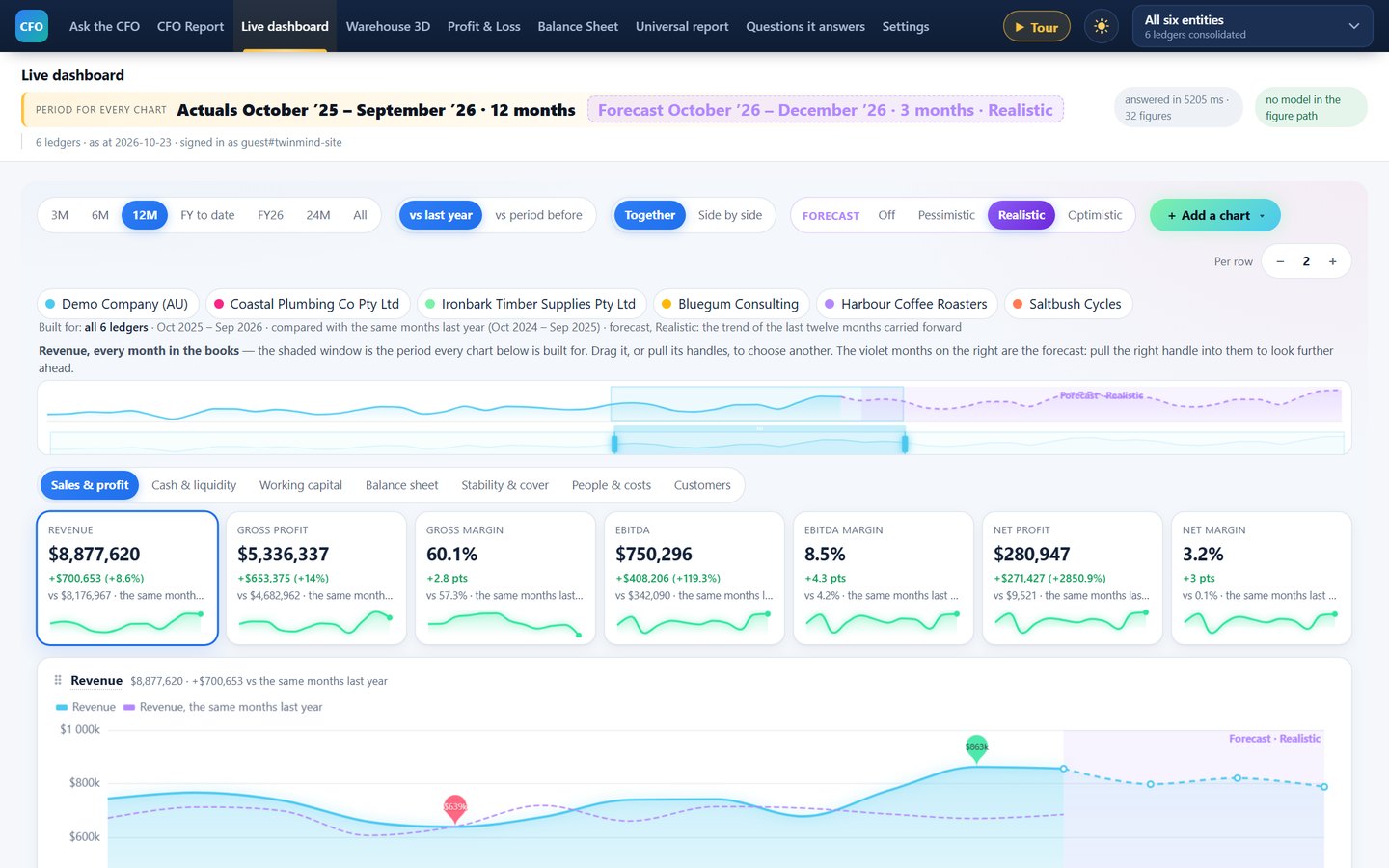
The live dashboard over six company files. The violet months on the right are the forecast. Drag the shaded window and every chart below follows it.
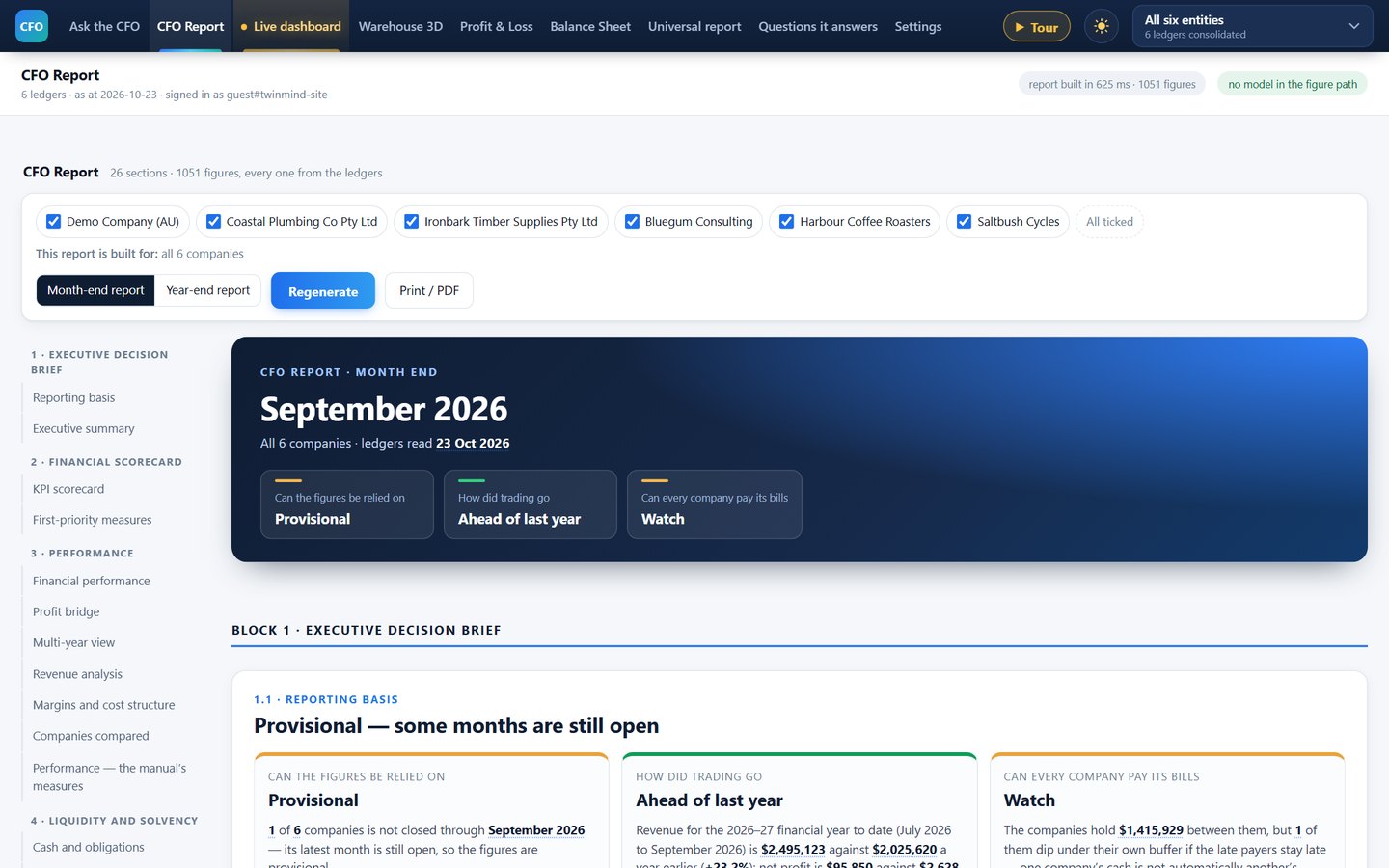
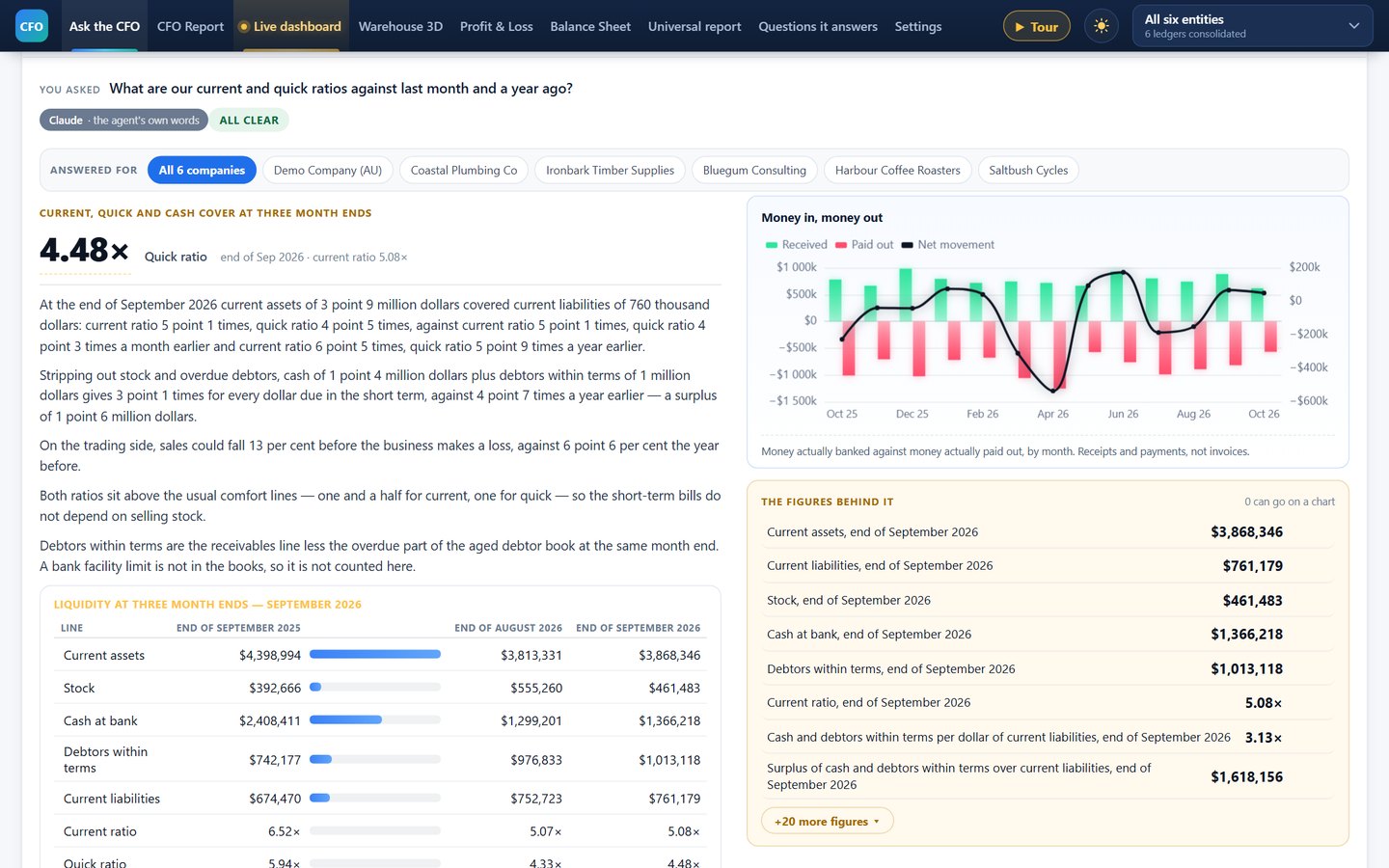
Open the virtual CFO → opens straight in: a live demo on sample ledgers
A pasta manufacturer with two hundred people. For twenty-five years the plant has run on a system Sergii wrote for it. He has looked after it ever since. The layer built on top now prices every product from its real cost.
How it sits on the plant
“We used to learn about losses at month-end. Now I see profit by product any minute.”
Owner, a pasta manufacturer in Ukraine
See the costing build →Discuss a costing or reporting task →
Twelve more systems, built and in use
More builds cover group reporting, quoting, product costing, hiring and daily admin. Every screen below is the real system playing, and each one opens.
What you are agreeing to
These five terms are the same for every client. They go into the agreement, and they hold for the whole build.
The first conversation is on us. The audit is A$2,000, credited in full against your first build. Scope and price are agreed in writing before any build starts, with the acceptance criteria and the payment terms.
1 hour
What the work looks like now and where it goes slowly. Video, or in person in South East Queensland. If a spreadsheet already carries the job, we say so in that hour.
On uswith the founders who would build it
1-3 days
Two questions answered in dollars. Which block of work to automate first, and what it costs you a year? Which extra service could you offer, and what would it earn?
A$2,000 fixedcredited in full against the first build
typically 1-2 weeks
One system at a time. Scope, acceptance criteria and price agreed in writing first. Integrations start from A$500. AI usage is billed at cost.
from A$6,000the code is yours
ongoing, optional
Monitoring, fixes and tuning as your rules and data change, plus the next steps worth taking. You own the system and can stop whenever it suits you.
from A$1,500a month
The costed plan from the audit is yours to keep, and you decide what to build with it. You pay for a build only once you approve its scope.
Book a 60-minute conversationEach one is the right answer for somebody. This is how the three compare, so you can tell which one is yours.
Option one
Option two
Option three

Who we are
We are twin brothers in Brisbane. Each of us is both at once. We are finance professionals who have carried a real ledger, and engineers who have built production systems.
Each of us has spent more than twenty years doing those two jobs at the same time. Alex built the accounting system a packaging group runs in twenty of its plants. The system Sergii built for an international voice business ran the whole company, with a hundred people working inside it every day.
Agents write the code under our design and standards. We review every line. We work as architects. Twenty years of building these systems ourselves is what makes that solid.
Built and hosted in Australia, inside your own environment.
Every step leaves a trail an auditor can follow.
Anything touching money or risk is approved by a named person.
Scope, acceptance criteria and price in writing before the work starts.
Have another one? Ask it in the conversation. The answer comes from the people who would build it.
You see the number before anything is built. The first conversation is on us. The opportunity audit is a fixed A$2,000, credited in full against your first build. It hands you a costed plan you approve before any build begins. Integrations start from A$500, and every build is a fixed price agreed up front.
Use it where it fits: it does good work inside its own ledger. We connect Xero, MYOB and your ERP around your process. Every figure comes from tested calculations.
The models we build on learned from a vast body of text. Our agents also work from your own company data: the full ledger history, your documents and your rules. The mistakes you hear about come from one agent working alone, from a small slice of knowledge, deciding everything by itself. Asked that way, roughly 20-30% of finance answers come back wrong.
We split every decision across several agents. Each one answers for its own part: one reads the documents, one runs the calculation, one checks the result against the records. An answer is released once they agree, and the figure itself always comes from tested code. With the agents cross-checking, that 20-30% falls to 0.0%.
Code produces every number. The AI decides which calculation to run and puts the result into words. The figure itself comes from code we test, and every figure opens to the records behind it. Anything that moves money is approved by a named person.
Finance and back-office work, end to end. Accounts payable: invoices read, coded and matched. Reconciliation: bank, intercompany and clearing accounts. Month-end close, consolidation and management reporting. Cash flow forecasting, free cash, working capital, liquidity and debtor days. Product costing, margin and stock visibility. Document work: forms, contracts and obligations. Each one is a custom AI system on your existing systems and workflows, with a live ERP dashboard on top.
Your systems stay. We automate the work around the tools you already run. We read from them and write back to them. They keep running as they do today.
Client systems are hosted in Australia. Human approval stays in place for money, risk and legal steps, and every action is logged for audit. We design around Australian privacy obligations from the start.
A focused first system is usually scoped in days and built over 1 to 2 weeks. We confirm the timing before the build starts.
You do, with us beside you if you choose. The code, the configuration and every record sit in your repository, and the care plan keeps the system tuned. From the first hour to the handover you work with the founders who own the outcome.
Australia, 2026
You work with the founders from the first conversation through to handover. We agree the delivery date in writing.
30-50 hoursa week of automatable work: what that first hour usually maps across a business. The hour ends with a plain answer on whether a build pays for itself.
Tell us where the work goes slowly. We will say plainly what a system would carry and what stays with a person. In person across Brisbane and South East Queensland, or by video.
Or talk to us right now, from this page:
We work with finance owners, CFOs and finance directors across Australia, and meet in person in Brisbane and South East Queensland.
Live video and voice calls run 9am to 5pm, Brisbane time. Chat, the AI assistant and email are open any time.